


What Most Red Light Therapy Sellers Get Wrong
The red light therapy market has grown rapidly in recent years, with more brands entering the wearable and home-use therapy segment. However, during OEM and ODM development, many sellers and brand owners unintentionally make product decisions that reduce therapeutic effectiveness, shorten product lifespan, or even create safety risks for end users.
At RedThera, we frequently analyze failed samples, customer complaints, and poorly engineered designs from the market. In this article, we summarize several common misconceptions and product development mistakes that red light therapy sellers should avoid.
Mistake #1: Reducing Core Component Quality to Lower Costs
Case 1: Low-Quality LEDs Without Proper Temperature Control
Some sellers use low-grade LEDs without NTC temperature control systems, which may lead to overheating, unstable thermal behavior, and even low-temperature burns during prolonged skin-contact use.
In wearable red light therapy products, excessive heat accumulation may cause low-temperature burns or skin discomfort, especially when the device is used in direct contact with the body for extended periods.
This issue is commonly caused by:
● unstable LED chips
● poor thermal resistance
● lack of temperature feedback control
● insufficient heat dissipation structure
Many sellers focus heavily on wavelength specifications while ignoring thermal management, even though thermal stability is one of the core foundations of wearable product safety.
Case 2: Low-Quality Flexible PCB (FPC)
To further reduce costs, some manufacturers use low-quality LED flexible PCBs (FPCs). These low-cost FPCs often have weak soldering reliability and poor fatigue resistance.
Wearable products naturally experience repeated bending and flexing during normal use. Low-grade FPC materials may crack at solder joints after repeated flexing cycles, causing partial LED failure or unstable lighting performance.
High-quality wearable FPC structures are specifically designed to withstand continuous bending stress over long-term use.
Case 3: Low-Cycle-Life Batteries
Another common issue seen in marketplace reviews is battery failure caused by low-quality rechargeable cells.
To reduce costs, some products use batteries with low cycle life and unstable discharge performance. After only a short period of usage, consumers may experience:
● reduced battery capacity
● charging instability
● inability to power on the device
● shortened product lifespan
For wearable devices, battery quality directly affects long-term user experience and brand reputation.
Analysis:
The core of wearable red light therapy products is the LED system itself. LED quality directly affects irradiance stability, heat generation, product lifespan, and treatment effectiveness.
However, many sellers lack the engineering knowledge required to distinguish high-quality LED systems from low-cost alternatives, leading them to select suppliers based primarily on price rather than performance and reliability
Mistake #2: Using Products in the Wrong Application Scenario
Case: Using a Red Light Therapy Blanket for Long-Distance Irradiation
Some sellers promote full-body red light therapy blankets by hanging them vertically and using them at a distance similar to a panel device. This usage method is fundamentally incorrect and cannot deliver effective therapeutic performance.
The reason is that red light therapy blankets and red light therapy panels use completely different LED structures and engineering logic.

Most wearable blankets use 5050 SMD LED chips. These LEDs are compact, flexible, and suitable for low-heat wearable applications that stay close to the body. However, their power output is typically only around 0.2W–0.5W per LED, resulting in limited irradiance and weaker long-distance penetration capability.
As distance increases, irradiance decays rapidly, especially in low-power wearable LED systems with wide beam angles.
For this reason, wearable blankets are designed specifically for close-contact therapy where the LEDs remain near the skin surface to ensure sufficient photon energy absorption by human tissue.
By contrast, red light therapy panels commonly use higher-power LEDs such as 3535 SMD or 5730 SMD structures. These LEDs typically operate at 1W–3W and require dedicated heat dissipation systems and optical lenses to achieve long-distance, high-density irradiation.
Therefore, the design logic of these products is entirely different:
| Product Type | Design Logic |
| Blanket | Close-contact wearable therapy |
| Wrap/Belt | Flexible body attachment |
| Panel | Long-distance high irradiance therapy |
Analysis:
Red light therapy sellers should understand different LED chip structures and product engineering logic in order to match the correct products with the correct usage scenarios.
Not all red light therapy products are designed for long-distance irradiation.
Mistake #3: Sacrificing Therapeutic Efficiency for Comfort
Case: Blocking Light With Low-Transmission Fabric Layers
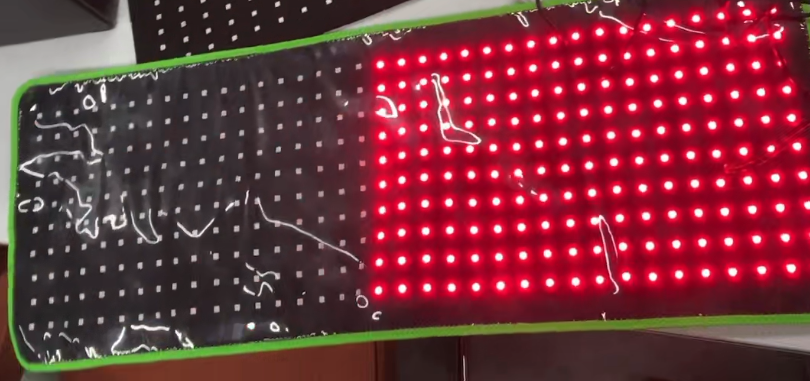
Some wearable red light therapy belts use black mesh fabric layers in front of the LEDs in order to improve comfort and reduce direct skin contact.
However, low-transmission fabrics introduce severe optical loss and significantly reduce the amount of photon energy that can penetrate the skin.
The working principle of red light therapy depends on light energy reaching human tissue and cells. Every additional layer placed between the LEDs and the skin introduces optical loss.
Many products appear visually bright to the human eye, but visible brightness does not necessarily mean effective therapeutic irradiance reaches the skin.

Testing results:
| Cover Layer | Irradiance |
| From unknown seller with black mesh layer | 0.2837 mW/cm² = 283.7 uW/cm² |
| From RedThera with Transparent TPU | 76.7 mW/cm² |
| From RedThera with Frosted TPU | 80.9 mW/cm² |
At this level, the remaining light is largely only visually visible red light and no longer provides meaningful therapeutic performance.
Analysis:
In wearable red light therapy design, comfort and therapeutic efficiency must remain balanced.
RedThera generally recommends using highly transparent TPU or frosted TPU materials because these materials maintain user comfort while minimizing optical energy loss.
A good wearable design should allow light energy to pass through the skin as directly and efficiently as possible instead of introducing unnecessary blocking materials.
Mistake #4: Excessive Focus on LED Quantity Instead of Real Irradiance
One of the most common misconceptions in the red light therapy industry is the belief that more LEDs automatically mean larger treatment coverage and better therapeutic results.
As a result, some sellers focus heavily on increasing LED quantity for marketing purposes while overlooking irradiance, which is one of the key factors that actually determines treatment effectiveness. This often leads to products that look impressive on paper but fail to deliver satisfactory real-world performance.
To better understand the relationship between specifications and therapeutic performance, it is important to distinguish the role of each parameter:
| Parameter | Primary Function |
| Wavelength | Determines therapeutic purpose |
| LED Quantity | Determines treatment coverage area |
| Irradiance | Determines therapeutic effectiveness |
| Power | Influences irradiance intensity |
To simplify the relationship between power, LED quantity, and irradiance, we can use a basic engineering concept:
Power ÷ LED Quantity = Average Irradiance Distribution
In simple terms, if total system power remains unchanged while LED quantity continues to increase, the average irradiance allocated to each LED will decrease.
This means that blindly adding more LEDs without increasing total available power may actually reduce the energy density delivered to the body.
For plug-in devices, increasing total power output is still relatively achievable because power supply limitations are lower.
However, the wearable red light therapy market is increasingly shifting toward wireless products due to convenience and portability. Wireless products rely on battery systems, which makes unlimited power increases impractical because of:
● battery capacity limitations
● heat generation
● thermal safety
● charging requirements
● device weight and comfort
As a result, wearable product development always requires balancing:
● LED quantity
● power consumption
● irradiance output
● battery performance
● thermal management
● overall user experience
Ultimately, the goal of red light therapy product engineering should not be maximizing LED quantity alone, but ensuring sufficient and stable photon energy can effectively reach human tissue.
Conclusion
In red light therapy product development, appearance and marketing specifications alone do not determine real therapeutic performance.
Factors such as LED quality, thermal management, optical transmission, structural engineering, and correct usage scenarios all directly influence whether effective photon energy can actually reach human tissue.
For OEM and ODM brands, understanding these engineering fundamentals is essential for building reliable and effective red light therapy products.

RedThera Red Light Therapy Supplies